Which Software Is Mostly Used in the Production Industry? After Effects, Nuke & Autodesk Smoke
 September 4, 2026
 By Admin


September 4, 2026
By Admin
The production industry has changed significantly with the growth of digital filmmaking, television, advertising, animation, and visual effects. Today, production houses use specialized software to create, edit, enhance, and deliver professional-quality content.
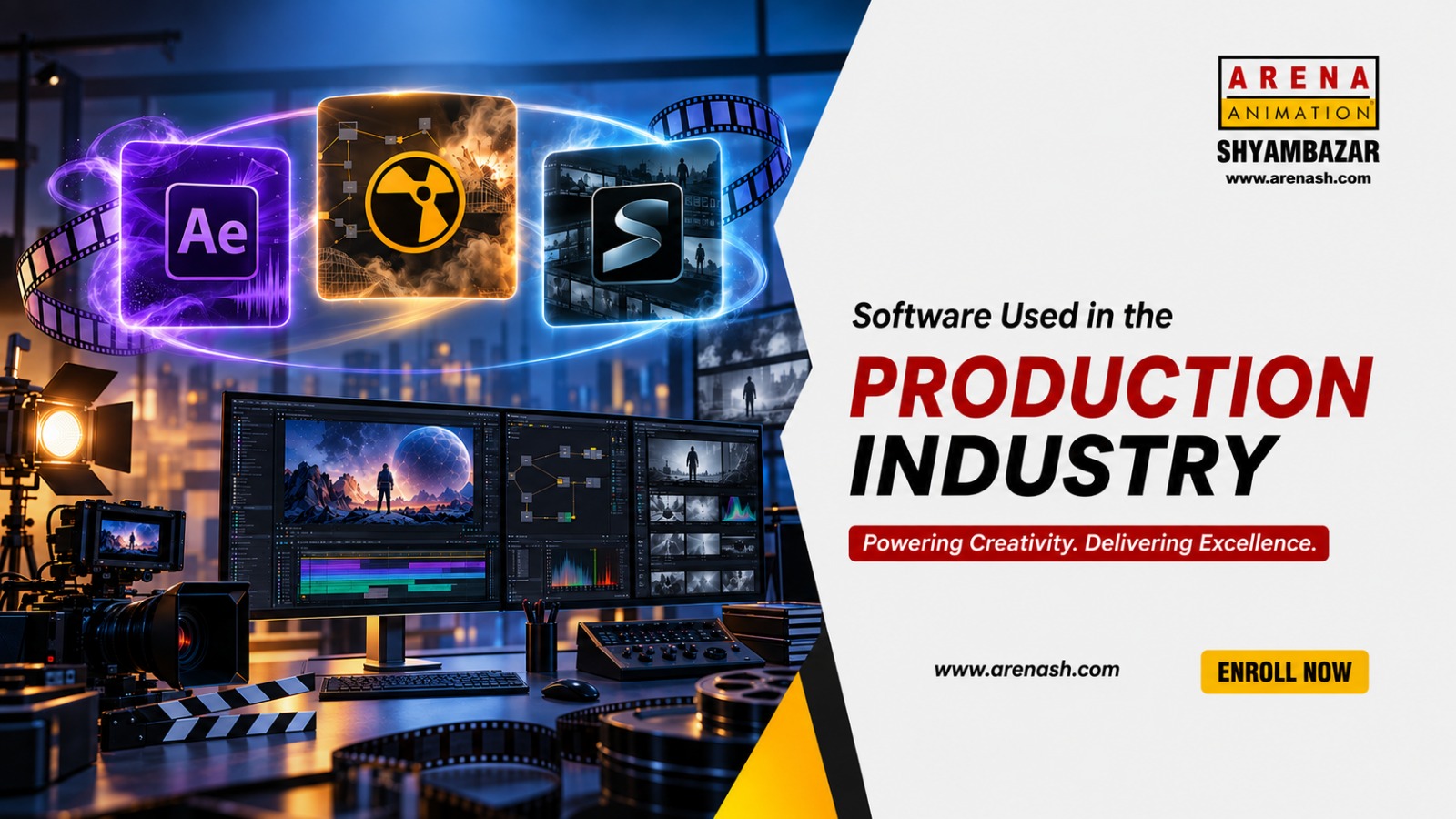
Among the many tools available, Adobe After Effects, Nuke, and Autodesk Smoke are well-known names in the post-production and visual effects workflow. However, each software is designed for different purposes, and understanding where each one fits is more important than simply knowing the software names.
For students and beginners planning a career in animation, VFX, or filmmaking, learning the right software can provide a strong foundation for entering the production industry.
Adobe After Effects is one of the most widely recognized tools for motion graphics, compositing, animation, and visual effects. It is commonly used in advertisements, social media videos, films, television content, title sequences, and promotional videos.
Designers and VFX artists can use After Effects to animate text, create visual effects, remove backgrounds, track objects, create transitions, and combine multiple visual elements into a single composition.
One major advantage of After Effects is its flexibility. A graphic designer can use it for simple motion graphics, while a VFX artist can use it for much more advanced compositing work.
As per me, After Effects is often a good starting point for students because it connects graphic design knowledge with animation and visual effects. If you already understand design principles, learning motion graphics in After Effects can feel like taking your static designs and giving them movement.
Nuke is a professional node-based compositing software widely associated with high-end film and visual effects production.
Unlike layer-based workflows, Nuke uses a node-based approach. This allows artists to create complex compositing pipelines where different visual elements can be connected, adjusted, and controlled independently.
Nuke is particularly useful when a production involves complex VFX shots, multiple layers, 3D elements, CG integration, green-screen footage, and detailed compositing.
For students interested in becoming professional compositors, understanding Nuke can be particularly valuable because it introduces a more structured approach to complex VFX workflows.
Autodesk Smoke has been known as a professional editing and finishing solution, particularly within broadcast and post-production environments.
Smoke combines editing capabilities with visual effects and finishing tools, making it useful for workflows where editing and compositing need to work closely together.
It has been used for tasks such as video editing, compositing, effects, color correction, and finishing.
However, it is important for students to understand that software popularity changes over time. Production studios regularly update their pipelines based on current technology, project requirements, hardware, and industry standards. Therefore, students should focus not only on learning one software package but also on understanding the fundamentals of editing, compositing, color, storytelling, and visual effects.
Although all three tools can be associated with post-production, they are not direct replacements for one another.
The best software depends on the role you want to pursue, rather than simply choosing the software that sounds the most advanced.
This is one of the most common questions students ask.
There is no single answer because your choice should depend on your career goal.
Our suggestion is simple: don’t learn software just because it is popular. Learn software according to the job you want to do.
A VFX artist is not valuable merely because they know Nuke or After Effects. Their real value comes from understanding how to solve visual problems, work with footage, maintain realism, follow a production pipeline, and deliver the required result.
Knowledge of production software can open opportunities across several creative industries.
Depending on your skills and specialization, you can explore roles such as:
The exact responsibilities can vary significantly between production houses, studios, advertising agencies, and independent projects.
At Arena Animation Shyambazar, students interested in animation, VFX, and creative production can focus on developing both software knowledge and practical creative skills. The objective should not simply be to collect software names on a résumé, but to build the ability to create and solve real-world visual problems.
Adobe After Effects, Nuke, and Autodesk Smoke represent different approaches to post-production and visual content creation. After Effects is widely associated with motion graphics and compositing, Nuke is strongly focused on professional VFX compositing, while Smoke has been used for editing, effects, and finishing workflows.
But the bigger lesson for anyone planning a career in the production industry is this: software changes, but production fundamentals remain valuable.
Learn the tools, understand the workflow, practice with real projects, and develop your creative problem-solving ability. That combination can give you a much stronger foundation than simply learning software commands.
If you are planning to build a career in animation, VFX, motion graphics, or post-production in Kolkata, choosing the right learning path based on your career goal can be the first important step.
Reach out to us using the form below!

October 14, 2026 | By Admin

October 1, 2026 | By Admin

September 23, 2026 | By Admin

September 16, 2026 | By Admin

September 10, 2026 | By Admin
September 4, 2026 | By Admin

August 27, 2026 | By Admin

August 19, 2026 | By Admin
August 17, 2026 | By Admin
August 5, 2026 | By Admin