Latest trends in the animation industry in 2026?
 June 8, 2026
 By Admin


June 8, 2026
By Admin
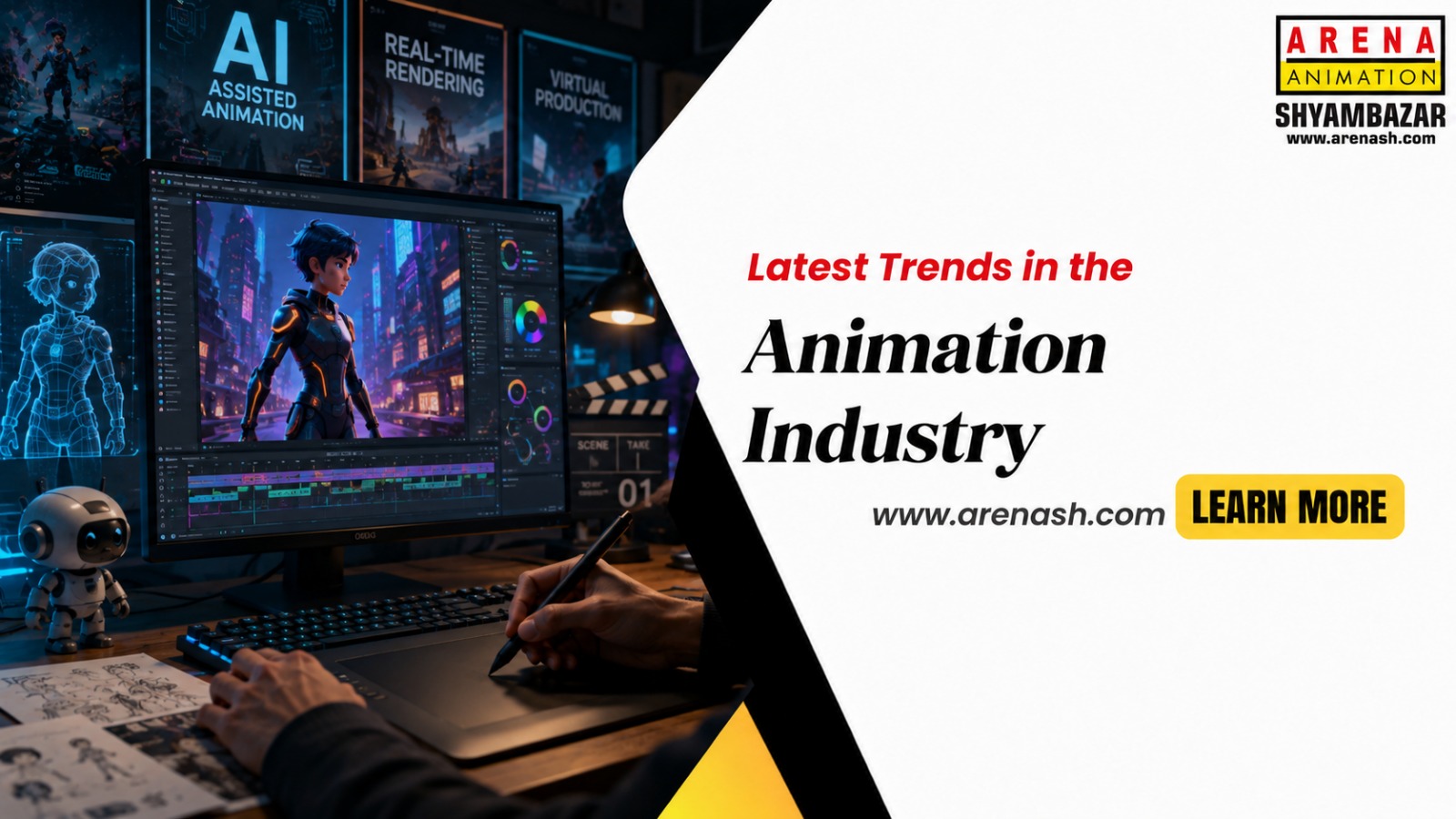
The animation industry in 2026 is undergoing a massive paradigm shift. Powered by a booming global entertainment market and India’s projected $2.2 billion animation and VFX sector, the creative landscape has completely evolved. The days of choosing between rigid 2D and hyper-polished 3D are gone. Today, the field is defined by hybrid aesthetics, intelligent automation, and instant rendering.
At Arena Animation Shyambazar, we welcome you to the absolute forefront of this digital revolution. As a premier institute deeply embedded within India’s creative capital, our mission is to decode these rapidly shifting global gears and convert them into a structured, future-proof career path for you. We don’t just train you to use software; we mentor you to lead production pipelines, command automated tools with artistic authority, and think like a global studio professional from day one.
Whether your dream is to design the next iconic cinematic universe, build interactive virtual worlds, or direct high-impact digital campaigns, your journey into the future of media begins right here.
The dominant aesthetic signature of 2026 is the blurring of boundaries between flat 2D art and complex 3D depth. Audiences are experiencing “generative fatigue” from hyper-polished, perfectly smooth 3D models. In response, major global studios and independent creators alike are pushing the boundaries of hybrid animation.
This trend combines the spatial consistency and dynamic camera movements of 3D software with the emotional warmth, textures, and lines of traditional, hand-drawn 2D animation.
Waiting hours or days for a single frame to process through a heavy render farm is becoming a thing of the past. In 2026, real-time rendering engines like Unreal Engine 5 and Unity have fully cross-pollinated from the gaming world straight into the core of film, television, and advertising animation workflows.
[Traditional Pipeline] -> Directing -> Asset Prep -> Animation -> Long Rendering -> Final Review
[Real-Time Pipeline] -> Directing + Asset Prep + Real-Time Viewport Review -> Instant Final Output
This structural shift transforms how production teams collaborate:
In 2026, Artificial Intelligence has become an essential part of the animation production process. Rather than replacing artists, AI is helping creative professionals work faster and more efficiently by automating repetitive technical tasks. This allows animators to dedicate more time to storytelling, character performance, visual creativity, and artistic decision-making.
Today’s animation software includes powerful AI-driven features that simplify many traditionally time-consuming processes. Tasks such as object tracking, scene masking, lip-sync generation, and motion capture cleanup can now be completed in a fraction of the time compared to older workflows. AI can automatically identify moving subjects, generate accurate mouth movements from audio tracks, optimize 3D assets, and refine motion capture data with minimal manual intervention.
These advancements significantly improve production speed, enabling studios to handle larger projects while maintaining high-quality standards. However, AI remains a support tool rather than a replacement for creative talent. Human artists continue to provide the imagination, emotional depth, storytelling skills, and artistic judgment that bring characters and worlds to life.
As a result, one of the most sought-after roles in the animation industry today is the AI Workflow Specialist—an artist who combines strong creative fundamentals with advanced AI tools to enhance productivity and deliver exceptional visual experiences. In 2026, the most successful animators are those who embrace AI as a creative partner while continuing to develop their artistic expertise.
As automated tools and predictable design templates flood digital feeds, perfect polish has lost its uniqueness. In 2026, visual craftsmanship has become a massive status symbol. Brands and elite studios are intentionally leaning into analog nostalgia and calculated imperfections to signal raw human authenticity.
Animation is no longer restricted to a 16:9 television or movie screen. The modern content ecosystem requires animation to be modular, responsive, and deployable across infinite platforms simultaneously.
For any aspiring creative stepping into the media industry today, these global trends highlight a critical truth: technical execution is automated, but creative thinking is irreplaceable.
Success in 2026 requires an educational framework that does not simply teach software shortcuts, but deeply instills production fundamentals. At Arena Animation Shyambazar, students are trained through a production-aligned curriculum designed to transform them into highly adaptive, multi-disciplinary professionals.
The Career Blueprint for 2026 Success
To remain competitive in this fast-moving market, your portfolio must showcase an explicit balance of classical knowledge and modern tech literacy:
The future of animation belongs to the creators who look at new technological tools not with anxiety, but as an open invitation to build bigger, bolder, and more deeply human stories. By mastering these 2026 trends early, you position yourself at the very front of the global entertainment frontier.
Reach out to us using the form below!
September 4, 2026 | By Admin
August 27, 2026 | By Admin
August 19, 2026 | By Admin
August 17, 2026 | By Admin
August 5, 2026 | By Admin
July 21, 2026 | By Admin

July 14, 2026 | By Admin
July 9, 2026 | By Admin
June 30, 2026 | By Admin

June 25, 2026 | By Admin