Can AI Replace Graphic Designers?
 August 27, 2026
 By Admin


August 27, 2026
By Admin
AI is a powerful tool, but it is not a human. It can support graphic designers by making certain tasks faster and easier, but it cannot completely replace human creativity, emotions, and understanding. AI may generate designs, but it cannot think and feel like a human or fully understand the emotional connection behind a brand.
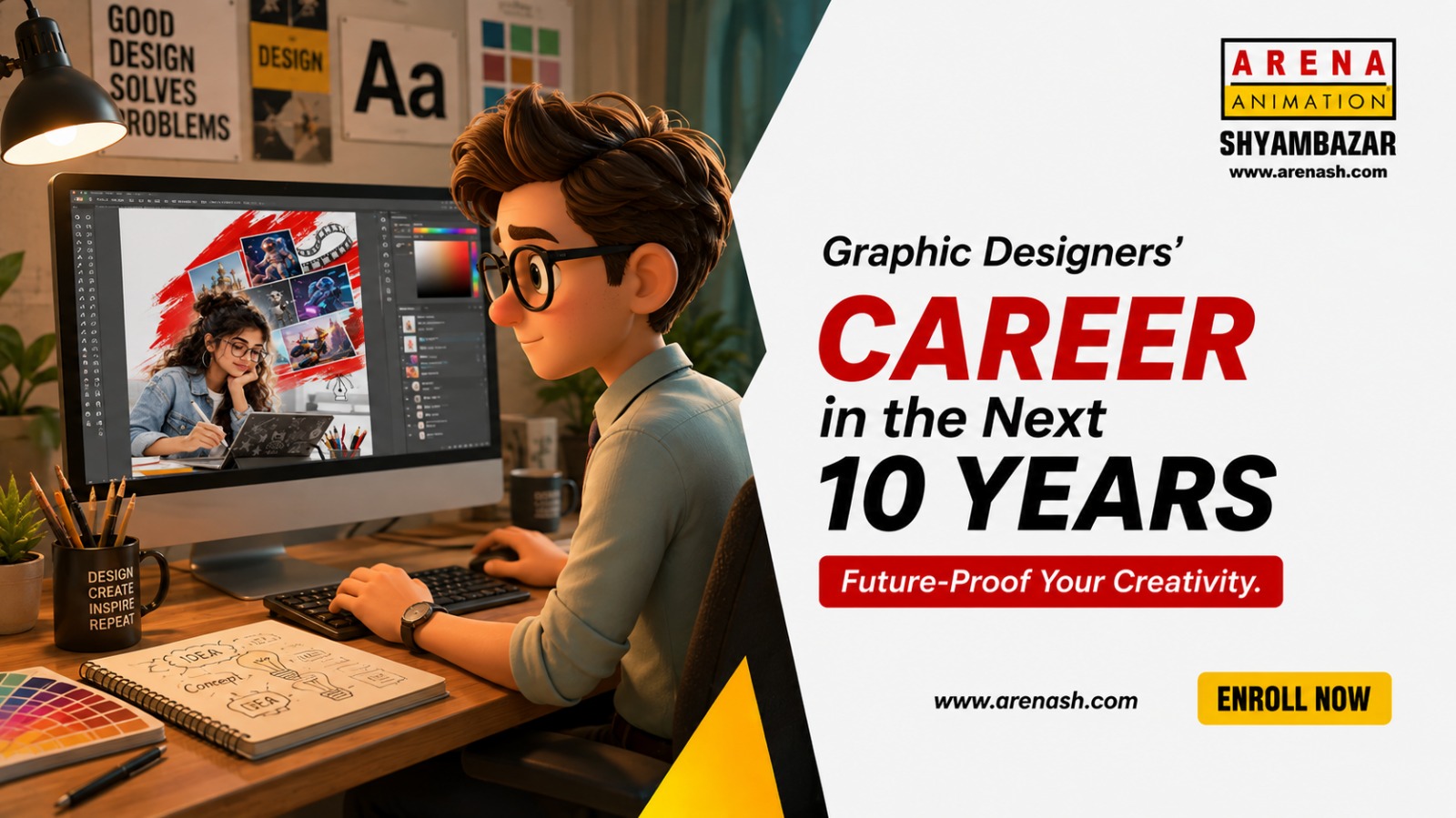
If we talk about a graphic design career over the next 10 years, the field can remain secure, but competition will definitely increase. Designers will need to think beyond simply creating attractive visuals. They will have to understand the business behind every design, what the business needs, what its goals are, who its target audience is, what the market demands, and how the design can strengthen the brand value.
The future belongs to designers who combine creative skills, business understanding, branding, and AI tools. AI can support your work, but your creativity, strategy, and human understanding will remain your biggest strengths.
By 2026, AI tools have moved from novelty to genuinely capable production assistants:
The gap isn’t in image quality anymore — it’s in judgment. AI can’t:
Most 2026 industry data points to task automation, not job elimination. McKinsey’s research on generative AI’s economic potential estimates that roughly 26% of tasks in arts and design occupations are automatable. That’s a meaningful chunk of the workday, but it’s a quarter of tasks, not the whole job.
Growth data backs this up: designers who use AI report higher job satisfaction than those who don’t, and designers with AI skills are earning significantly more than peers who lack them. At the same time, projected growth differs by specialty — roles closer to UX and strategy are expanding faster than pure production-graphics roles.
Looking a decade out, the more likely shift is a redefinition of the job: less time pushing pixels manually, more time on concept development, brand systems, AI-output curation, and creative direction.
“Dangerous” is the wrong lens — “disruptive” is more accurate, and the disruption isn’t evenly spread:
The real risk isn’t AI itself; it’s staying a purely execution-focused designer while the market shifts toward strategy and taste.
AI and Graphic Design Controversy
The debate around AI in design isn’t purely technical — it’s also ethical and economic, and several flashpoints keep recurring:
AI in the Graphic Design Industry Right Now
The industry has effectively split into two lanes in 2026:
Mainstream tools shaping this landscape include Adobe Firefly, Midjourney, Canva Magic Studio, Leonardo.Ai, Flux.1, and newer entrants like Claude Design. Agencies and in-house teams are increasingly hiring for hybrid skill sets — design fundamentals plus fluency in AI tools — rather than treating design software skill and AI skill as separate tracks.
Rather than disappearing, the graphic design career path is branching. Roles gaining traction include:
To stay competitive, designers are increasingly encouraged to master AI tools like Midjourney and Photoshop’s Generative Fill as support for the design process rather than a replacement for it, sharpen storytelling and narrative skills, and specialize in areas that need a human touch, UX, branding, or campaign strategy.
AI will replace some tasks and some roles, but it will not replace design itself, and it will not replace designers who bring creativity, strategy, and genuine human communication to the table. The designers thriving in 2026 aren’t the ones ignoring AI or panicking about it — they’re the ones using it as a production accelerator while doubling down on the judgment, taste, and originality that no model can fake.
AI will transform the animation, graphic design, VFX, and web design industries, but roles requiring creativity, storytelling, human judgment, and problem-solving will remain valuable. Creative Directors, Art Directors and Concept Artists, VFX Supervisors, UX/UI and Web Designers, and 3D Animators and Motion Designers all require a strong human understanding of visual communication and creative decision-making. AI can assist these professionals, but it cannot fully replace their creative vision, experience, and ability to understand people and project goals.
Yes, if you evolve with it. Designers who combine core design fundamentals with AI fluency, storytelling, and brand strategy are finding more opportunity, not less — many report higher earnings and job satisfaction than peers who avoid AI tools entirely.
Yes, but the bar has moved. “I can make things look clean” is no longer a sufficient value proposition on its own, since non-designers can now get decent output from Canva or Firefly. Designers who add strategic thinking, a distinct style, or specialized expertise are still very much in demand.
It will automate a meaningful share of repetitive execution work — resizing, basic layouts, simple asset variations — while shifting designers’ time toward concept development, creative direction, AI-output curation, and client-facing strategy.
Purely execution-based, template-driven roles with no strategic or brand component are most at risk; think high-volume basic social graphic production with no creative direction attached. Roles centered on originality, brand ownership, and complex craft (packaging, editorial, motion, UX) are expected to persist and evolve rather than disappear.
Reach out to us using the form below!
October 1, 2026 | By Admin
September 23, 2026 | By Admin
September 16, 2026 | By Admin

September 10, 2026 | By Admin

September 4, 2026 | By Admin
August 27, 2026 | By Admin
August 19, 2026 | By Admin
August 17, 2026 | By Admin
August 5, 2026 | By Admin
July 21, 2026 | By Admin