How to Become a 3D Animator After 12th?
 August 17, 2026
 By Admin


August 17, 2026
By Admin
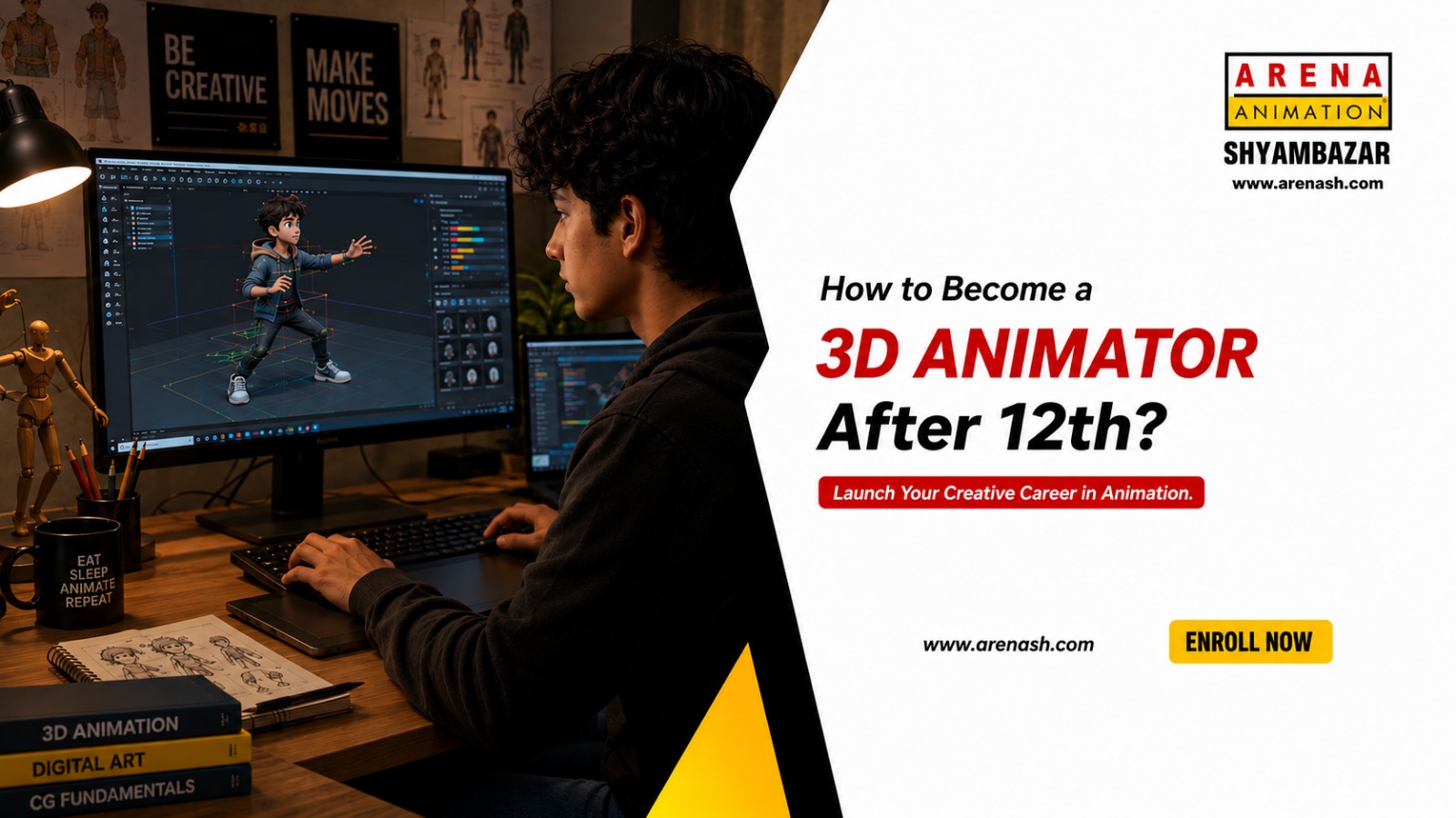
If you have just completed Class 12 and are interested in animation, movies, gaming, visual effects, or digital content, becoming a 3D animator can be an exciting career option. A 3D animator brings characters, objects, and environments to life by creating movement and expressions using specialized digital tools.
The good news is that you do not need to belong to a particular stream to start learning animation. Students from Arts, Science, or Commerce can pursue animation after 12th if they have creativity, visual imagination, and an interest in learning digital technology. Arena Animation Shyambazar also lists 10+2 from any stream as an eligibility route for its animation programs.
A 3D animator creates movement in digitally created characters, objects, and scenes. The animator studies body movement, expressions, timing, weight, and storytelling to make a digital character appear natural and believable.
3D animation is used across several industries, including films, television, advertising, gaming, digital media, and visual effects. Depending on their skills and specialization, professionals can work as 3D animators, character animators, 3D generalists, rigging artists, lighting artists, or other related roles.
The first step is to complete Class 12 from a recognized board. You can choose Arts, Commerce, or Science based on your interests and academic goals. For animation training, having a creative mindset and willingness to learn are particularly important.
After completing 12th, you can explore professional animation courses that introduce you to the artistic and technical aspects of 3D production.
Before focusing only on software, develop a strong understanding of animation principles. These fundamentals help you create movement that looks convincing rather than simply moving an object from one position to another.
You should learn concepts such as timing, spacing, squash and stretch, anticipation, follow-through, arcs, staging, pose-to-pose animation, and character acting.
These principles form the foundation for professional animation and become especially important when creating character performances.
Step 3: Learn 3D Modelling and Character Creation
A professional 3D production pipeline involves more than animation alone. Understanding how 3D models and characters are created gives aspiring animators a better understanding of the complete workflow.
Arena Animation Shyambazar’s 3D Animation course covers areas including 3D modelling, character creation, texturing, rigging, lighting, and animation.
Learning these connected areas can help you understand how a character moves from an initial concept to a finished animated scene.
Software skills are an important part of becoming a 3D animator. Depending on your learning path, you may work with tools such as Autodesk Maya, Blender, and other industry-relevant software.
Arena Animation Shyambazar currently offers short-term training options including Blender and Master in Maya, while its broader animation programs incorporate Maya/Blender-based digital graphics and animation training.
However, learning software alone is not enough. Your ability to create good animation, understand movement, tell a story, and produce a strong portfolio will ultimately matter greatly.
Rigging is the process of creating a digital skeleton and control system that allows a 3D character to move.
As an aspiring character animator, understanding basic rigging helps you work more effectively with production pipelines. You should understand how joints, controls, constraints, and character deformation affect animation.
This knowledge can also help you collaborate more effectively with character modellers and rigging artists.
Once you understand the fundamentals, start creating animation exercises. Begin with simple movements and gradually work toward more complex character performances.
You can practice a bouncing ball, walk cycle, run cycle, jumping animation, lifting an object, facial expressions, and short character-acting scenes.
The objective should not simply be to complete more projects. Focus on improving timing, movement, weight, acting, expressions, and storytelling with every project.
A portfolio is one of the most important assets for an aspiring animator. Instead of showing every exercise you have ever created, select your strongest work. Include projects that demonstrate different abilities, such as character animation, body mechanics, facial animation, acting, and short storytelling sequences.
A well-presented portfolio can help potential employers understand your creative ability and technical skills.
Animation is a practical field, so working on real-world projects can be extremely valuable. Projects allow students to understand production workflows, deadlines, feedback, revisions, and collaboration.
Arena Animation Shyambazar highlights live projects and practical learning as part of its animation training approach.
Students can use these projects to strengthen their portfolios and gain experience working with industry-style requirements.
After developing your basic skills and portfolio, look for internship opportunities with animation studios, VFX companies, gaming companies, advertising agencies, or digital media organisations.
An internship can expose you to professional workflows and help you understand how animation projects are created in a real production environment.
It can also help you identify which area of 3D animation interests you most.
After training, you can specialize according to your interests and strengths. Career options can include 3D Animator, 3D Modeller, Character Designer, Texturing Artist, Lighting Artist, Rigging Artist, 3D Generalist, FX Artist, and Previsualization Artist. Arena Animation Shyambazar lists these and other related career options for its professional animation and VFX training.
If you are particularly interested in games, you can also explore game art and character animation. Arena Shyambazar offers a 3D Digital Game Art & Design program with career paths such as Game Character Animator, Game Rigging Artist, Game Character Designer, and Game Play Animator.
A successful 3D animator needs a combination of creative and technical skills. Drawing knowledge can help you understand poses and proportions, while observation skills help you reproduce realistic movement.
You should also develop storytelling, acting, patience, attention to detail, problem-solving, communication, and time-management skills. Most importantly, you need consistent practice because animation is a skill that improves through repeated work and feedback.
Learning independently through online tutorials can help you understand the basics, but structured training can provide a more systematic learning path. Professional training can combine software learning, animation principles, practical projects, mentor guidance, portfolio development, and exposure to production workflows.
Arena Animation Shyambazar offers 3D animation training covering areas such as modelling, character creation, texturing, rigging, lighting, and animation. Its animation programs are designed around practical skill development and industry-oriented learning.
Start Your 3D Animation Career After 12th
If you have completed Class 12 and dream of creating animated characters, cinematic scenes, games, or visual content, 3D animation can give you a path into the creative-media industry.
The journey starts with choosing the right training, learning animation fundamentals, mastering relevant software, practising regularly, building a strong portfolio, and gaining practical experience. With the right combination of creativity, technical knowledge, and consistent practice, you can work toward a professional career as a 3D animator.
For students in Kolkata looking for structured animation training, Arena Animation Shyambazar offers 3D animation programs with eligibility starting from 10+2 and training focused on practical animation skills.
Can I become a 3D animator after 12th?
Yes. Students who have completed 10+2 can pursue professional 3D animation training. Arena Animation Shyambazar accepts students from Arts, Science, and Commerce backgrounds for its animation programs.
Is Science compulsory for 3D animation?
No. Students from Arts, Commerce, and Science streams can pursue animation courses, provided they have an interest in creative and digital work.
Which software should I learn for 3D animation?
Maya and Blender are useful software options to learn. The right choice depends on your career goal, course structure, and specialization. Arena Animation Shyambazar offers training options involving both Maya and Blender.
How long does it take to learn 3D animation?
The duration depends on the course and depth of training. Arena Animation Shyambazar currently lists its 3D Animation course as a 24-month program, while shorter options such as Blender and Maya-focused courses are also available.
What jobs can I get after learning 3D animation?
Depending on your specialization and portfolio, you can explore roles such as 3D Animator, 3D Modeller, Character Designer, Texturing Artist, Lighting Artist, Rigging Artist, 3D Generalist, FX Artist, and Previsualization Artist.
Is a portfolio important for a 3D animator?
Yes. A portfolio allows employers to evaluate your animation quality, creativity, technical skills, character movement, storytelling, and overall production ability. Building a strong portfolio should therefore be an important part of your learning journey.
Reach out to us using the form below!
October 1, 2026 | By Admin
September 23, 2026 | By Admin
September 16, 2026 | By Admin

September 10, 2026 | By Admin
September 4, 2026 | By Admin
August 27, 2026 | By Admin

August 19, 2026 | By Admin
August 17, 2026 | By Admin
August 5, 2026 | By Admin
July 21, 2026 | By Admin