The Role of CGI, Motion Tracking, and Compositing in Today’s VFX Industry
CGI, motion tracking, & compositing are the three major techniques that silently but powerfully contribute to almost all the modern movies, series, ads, and web videos you like today. Their combination enables the VFX artists to mix the digital and the live action so perfectly that the viewers hardly ever see the point separating reality and the visual effects.
What CGI, Motion Tracking & Compositing Really Mean
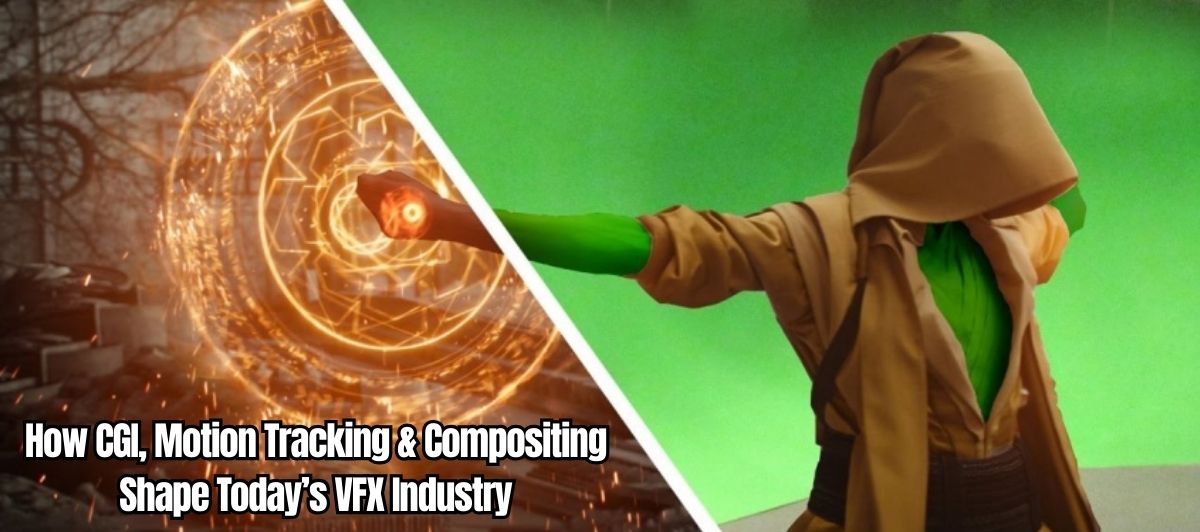
CGI Motion Tracking & Compositing might seem like a very wrought and technical terms but they actually represent a very simple concept: the production of digital elements, correctly controlling their movements in a scene, and finally merging everything into one picture. CGI (Computer-Generated Imagery) implies the whole realm of anything produced either in 3D or 2D digitally including creatures, explosions, and even whole cities.
Motion tracking (also called matchmoving) is the technique of examining a live-action video and taking out the movement of the camera or object so that digital elements can actually move along with that motion. Compositing is the last step where live footage, CGI, colour corrections, and effects are combined to create the illusion of a single, natural shot.
How CGI Drives the Modern VFX Look
The use of CGI technology has become a crucial point in the modern day VFX film making as it provides the real life fantasy worlds, heroes, hordes, and vehicles or dangerous stunts, etc. Artists start with modeling a digital asset, then they apply the texture, lighting and animation done in such a way that it balances the real-life materials and physics.
CGI is the only way to let the director think completely out of the box when it comes to practical sets and props, whether it be a minor digital set extension or a completely animated character. For VFX aspirants, the knowledge of the technology behind CGI from the initial planning stage through the creation process to the integration stage is an important part of the learning curve to get into the industry.
Why Motion Tracking Is the Invisible Backbone
No matter how beautiful the CGI is, it will fall apart if it “floats” or slides in the frame. This is solved in motion tracking by locking digital elements to the real camera movements, actor motion, or objects in the shot. The software analyses its frames, follows points or features and generates a virtual camera that also behaves like a real one.
This is how a digital robot can be made to walk down a real street or a hologram can be made to sit perfectly on a moving phone screen. Accuracy in motion tracking is important if your goal is to learn VFX for film, TV or content that combines live action with digital graphics.
Compositing: Where the Magic Finally Comes Together
Compositing is often described as the “last stop” in the VFX pipeline, where everything must look perfect. Compositors take live-action plates, CGI renders, mattes, motion-tracked data, and effects passes, then blend them using masks, keying, colour grading, and subtle tricks like glows, grain, and depth of field.
Good compositing hides the line between real and digital. Even simple shots—like adding screens, signs, or cleaning up unwanted elements—require strong compositing skills. Mastering this part of CGI Motion Tracking & Compositing can make a huge difference to your employability in a studio environment.
Why These Skills Are Core for Beginners
If you want to learn VFX and join the industry, building a foundation in CGI Motion Tracking & Compositing is more important than chasing “fancy” tools or plug-ins. These are the skills that studios use every day, on projects of every scale.
Beginners who understand how these three areas of planning CGI, tracking the shot, and compositing connect, the final image becomes easier to work within a professional pipeline. Even simple practice projects, like replacing a phone screen or adding a digital object to your street footage, can teach you this interconnected workflow.
How a Visual Effects Course Can Help
A structured visual effects course over self learning can speed up your learning journey by giving you a proper structure to follow, real-world assignments, and expert feedback. You get to practice CGI Motion Tracking & Compositing in a guided way instead of guessing the order of steps on your own.
A good visual effects course syllabus will typically cover fundamentals of 3D, tracking, keying, rotoscoping, and compositing, while helping you build a showreel that highlights these skills. For students after 10th or 12th and career-switching professionals, this combination of theory, software, and portfolio-building is often the bridge between “learning at home” and actually working in the VFX industry.


 December 13, 2025
 By Admin
 Learn VFX,VFX vs CGI,











 +91 9836221155
