Enquire Now

    Enquire Now

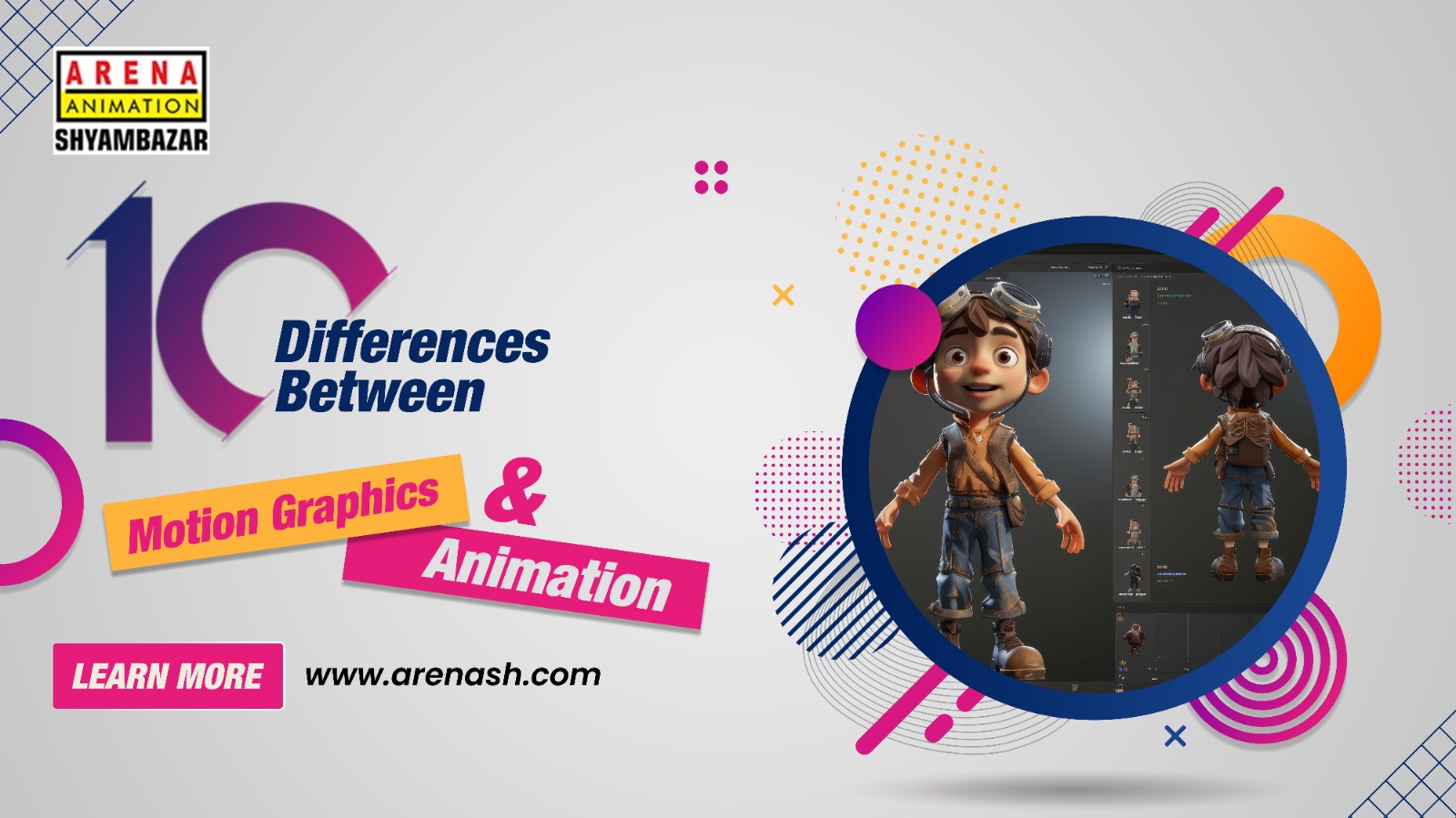
    10 Key Differences Between Motion Graphics and Animation

    April 1, 2026 By Admin

    Look, we’ve all been there. You’re watching a slick video explaining a new tech startup, or maybe the opening credits of a Netflix show, and you think to yourself, “Is this animation? Or is it motion graphics?” Honestly, the internet confuses these two all the time. People toss the words around in boardrooms and client emails like they mean the exact same thing. Spoiler alert: they don’t.

    Yes, technically speaking, motion graphics is a slice of the animation pie. If things are moving on a screen, it’s animated. But in the actual creative industry? They are two totally different animals. They do different jobs, cost different amounts of money, and require totally different skill sets.

    At Arena Animation Shyambazar, we believe in providing absolute clarity to our students so they can choose the career path that best aligns with their passions and skills. In this comprehensive guide, we will dive deep into the world of digital movement and explore the 10 key differences between motion graphics and animation.

    Understanding the Basics

    Before we dissect the differences, let’s define the core essence of both mediums.

    What is Animation?

    Animation is the overarching umbrella term for the process of creating the illusion of motion and change by rapidly displaying a sequence of static images that minimally differ from each other. At its heart, animation is a storytelling medium. It focuses on characters, environments, and narratives. Whether it is a traditional 2D hand-drawn masterpiece, a sophisticated 3D animated feature film, or stop-motion, animation is designed to take the viewer on an emotional journey alongside a protagonist.

    What is Motion Graphics?

    Motion graphics can be described as graphic design in movement. It is a specific subset of animation. Instead of focusing on character-driven narratives, motion graphics brings abstract shapes, logos, text, and design elements to life. Its primary goal is not to tell a complex cinematic story, but to communicate information, explain a concept, or promote a brand in an engaging, visually appealing, and digestible manner.

    The 10 Key Differences Between Motion Graphics and Animation

    1. Core Purpose and Objective

    The most fundamental difference lies in why the content is being created.

    • Animation is created to entertain and tell a story. It is a cinematic experience where the creator builds a world and populates it with characters that audiences can connect with emotionally.
    • Motion Graphics, on the other hand, is highly functional. It is created to inform, educate, or direct the viewer. Whether it is an animated pie chart showing quarterly growth or a kinetic typography video explaining a new software feature, the objective is communication and clarity, not narrative entertainment.
    1. Narrative Structure vs. Concept Delivery

    • Animation relies on a traditional narrative arc. It requires a beginning, middle, and end. It involves character development, conflict, climax, and resolution. The narrative dictates the visual choices.
    • Motion Graphics is concept-driven. It does not need a traditional story arc. Instead, it relies on a logical flow of information. It introduces a problem, visually demonstrates the solution, and often ends with a clear Call to Action (CTA). The design and movement serve the data or the core message.
    1. Visual Elements and Style

    • Animation heavily features characters, complex backgrounds, and detailed environments. Animators must study human anatomy, physics, gravity, and acting to make their characters’ movements believable and expressive.
    • Motion Graphics is rooted in graphic design principles. The visual elements consist of geometric shapes, abstract forms, vector illustrations, brand assets, and typography. The focus is on composition, color theory, grid systems, and smooth transitions rather than anatomical accuracy.
    1. The Role of Typography

    • In Animation, typography is usually an afterthought or relegated to specific necessities like opening title sequences, lower thirds in a documentary, or end credits. It rarely interacts with the main characters or drives the plot forward.
    • In Motion Graphics, typography is often the star of the show. “Kinetic typography” (moving text) is a massive part of the industry. Motion designers use text to emphasize spoken words, guide the viewer’s eye, and ensure the message is understood even if the video is watched on mute (a common occurrence on social media platforms).
    1. Emotional Impact vs. Cognitive Clarity

    • Animation seeks to evoke a strong emotional response. A well-animated sequence can make you laugh, cry, feel terrified, or experience profound joy. The animator acts through their characters to touch the audience’s heart.
    • Motion Graphics targets the brain. Its goal is cognitive clarity—making complex data or abstract ideas easy to understand. While a good motion graphics piece can be exciting or visually satisfying, its success is measured by how well the viewer understood the information presented, not by how deeply they felt for a character.
    1. Software and Industry Tools

    While there is some crossover, the software pipelines for these two disciplines often differ significantly.

    • Animators typically rely on software built for rigging and frame-by-frame character manipulation. Industry standards include Autodesk Maya, Blender, ZBrush (for 3D), and Toon Boom Harmony, TVPaint, or Adobe Animate (for 2D).
    • Motion Graphics Artists live and breathe in compositing and design software. Their primary weapon of choice is Adobe After Effects, usually supplemented by Adobe Illustrator and Photoshop for creating assets. For 3D motion graphics, Maxon Cinema 4D is the undisputed industry leader due to its seamless integration with After Effects and its powerful MoGraph toolset.
    1. Time and Cost of Production

    • Animation is notoriously time-consuming and expensive. Creating a character-driven story involves extensive pre-production (scripting, storyboarding, animatics, voice recording), complex production (modeling, rigging, animating every subtle facial expression), and post-production (lighting, rendering, compositing). A simple 5-minute animated short can take a team of artists months to complete.
    • Motion Graphics generally has a faster turnaround time and a lower production cost. Because it deals with simpler shapes, vectors, and typography without the need for complex character rigging or lip-syncing, a single skilled motion designer can often complete a high-quality 60-second explainer video in a matter of weeks.
    1. Audio Integration and Sound Design

    • Animation relies heavily on dialogue and voice acting. Lip-syncing—the meticulous process of matching a character’s mouth movements to recorded audio—is a massive part of the animator’s job. It also requires complex Foley work and orchestral scores to set the mood of a scene.
    • Motion Graphics utilizes audio differently. While it often features a professional voiceover to guide the viewer through the information, there is no lip-syncing involved. Sound design in motion graphics is punchy and stylized—using whooshes, pops, and clicks to emphasize the movement of shapes and text on screen, usually backed by an upbeat, royalty-free instrumental track.
    1. Commercial Applications and Industries

    • Animation is the backbone of the entertainment industry. You will find animators working in feature films, television series, video game development, and producing independent short films.
    • Motion Graphics dominates the corporate and commercial sectors. Motion designers are essential for digital marketing, advertising agencies, UI/UX design (creating micro-interactions on apps), broadcasting (creating news intros and sports graphics), and corporate communications (internal training videos and presentations).
    1. Required Skillsets and Career Paths

    • To succeed in Animation, you need the soul of an actor and the eye of an observer. You must understand timing, spacing, weight, and human psychology. Animators often specialize in very specific niches, such as 3D character animation, creature animation, or layout.
    • To succeed in Motion Graphics, you need a strong foundation in traditional graphic design. You must understand layout, color palettes, typography, and visual hierarchy. Motion designers are often generalists who handle a project from storyboard to final render, making them highly versatile assets in marketing teams.

    Why Choose Arena Animation Shyambazar?

    Whether you are mesmerized by the magic of character animation or drawn to the sleek, communicative power of motion graphics, your journey begins with the right education.

    At Arena Animation Shyambazar, we are proud to be one of Kolkata’s premier institutes for digital arts and media. We understand that the industry is evolving rapidly, which is why our curriculum is constantly updated to meet global standards.

    Here is why aspiring artists choose us:

    • Industry-Relevant Curriculum: We offer comprehensive courses tailored specifically for both 3D/2D Animation and Motion Graphics/VFX. You learn what the top studios are demanding today.
    • Expert Faculty: Our instructors are seasoned professionals with years of hands-on industry experience. They do not just teach software; they teach the underlying principles of art, design, and movement.
    • State-of-the-Art Infrastructure: Practice on high-end workstations equipped with the latest industry-standard software, including Maya, Cinema 4D, After Effects, and more.
    • Placement Assistance: We are committed to your success beyond the classroom. Arena Animation Shyambazar has a dedicated placement cell that connects top-performing students with leading studios, advertising agencies, and corporate houses across India.

    The world is visual, and the future belongs to those who can bring those visuals to life. Whether you want to tell the next great cinematic story or design the next viral brand campaign, Arena Animation Shyambazar is your launchpad.


    Frequently Asked Questions (FAQs)

    Can I learn both motion graphics and animation simultaneously, or should I choose one?

    While the foundational principles of movement (timing, spacing, easing) apply to both, we recommend mastering the basics of one before diving deeply into the other. For instance, a strong foundation in graphic design and After Effects (Motion Graphics) can be a great stepping stone. However, many successful artists eventually become “generalists,” understanding both to increase their employability.

    Which career path offers better freelance opportunities in today’s market?

    Generally, Motion Graphics offers more abundant and consistent freelance opportunities. Because every modern business—from local startups to massive corporations—needs promotional videos, social media content, and explainer videos, the demand for freelance motion designers is incredibly high and projects have faster turnaround times. Animation freelance work exists, but projects are often longer and usually require joining a studio pipeline.

    Do I need to be incredibly skilled at drawing to succeed in motion graphics?

    Not necessarily. While basic sketching skills help for storyboarding and visualizing ideas, motion graphics relies much more heavily on graphic design skills, layout, typography, and software proficiency. You will spend more time manipulating vectors, shapes, and text than you will hand-drawing complex illustrations. However, for traditional 2D character animation, strong drawing skills are absolutely mandatory.

    How is the rise of Artificial Intelligence (AI) affecting motion graphics and animation careers?

    AI is rapidly becoming a powerful assistant rather than a replacement. In both fields, AI tools are automating tedious tasks like rotoscoping, generating background assets, or suggesting color palettes. This allows artists to focus more on the creative direction, storytelling, and complex problem-solving that AI cannot replicate. Adapting to AI tools will make you a faster, more valuable artist in the industry.

    Is 3D modeling a mandatory skill for a career in motion graphics?

    It is not strictly mandatory, as a vast amount of motion graphics work is purely 2D (done in After Effects). However, the industry is increasingly blending 2D and 3D. Learning basic 3D modeling and texturing—especially in software like Cinema 4D—will give you a massive competitive advantage, allowing you to create high-end, dynamic product commercials and broadcast graphics that 2D simply cannot achieve.


    Leave a Reply

    Your email address will not be published. Required fields are marked *

    Related Posts

    FREE Animation Camp

    Our FREE Animation Camp opens up the world of animation with expert guidance, challenges and fun projects. Discover your potential with our animation course today!